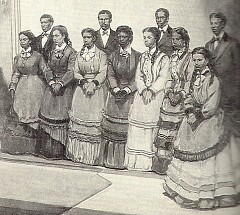
|
The 1871 Broadcast
Imagined September 2021
...
And thus, dear listeners, on this 16th of November in the year of
our Lord 1871, we have reached the intermission of this session of
the Congregational Council. Tomorrow we anticipate the formal
establishment of the denomination to be known as the National Council
of the Congregational Churches of the United States of America.
|
 |
|
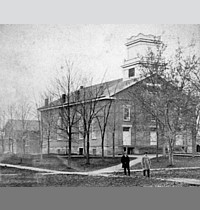
The
delegates are gathered this week in a large Congregational house of
worship, the Meeting House of Charles Grandison Finney's renowned
First Church in Oberlin, Ohio.
Our
broadcast location happens to be located next to the delegation from
the state of New-York, namely Rev. George Pelton of Candor, Rev.
Butler of Fairport, and Mr. Clark Bell of New-York City. |
Oberlin,
as I'm sure you are aware, is the home of Oberlin College, the
nation's first racially integrated institution of higher
learning. The redemption
of the recently emancipated slaves is here considered to be a holy
calling, and many missionaries have been trained.
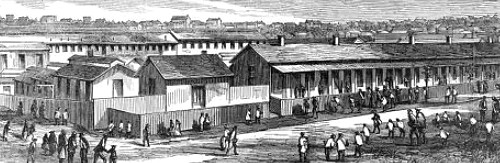
Some
of those emissaries to the freedmen have joined the faculty of Fisk
Free Colored School, which opened five years ago in Nashville,
Tennessee. During the late Civil War, the ground upon which it
now stands was under the control of Union forces and hosted an
encampment of fleeing slaves.
|
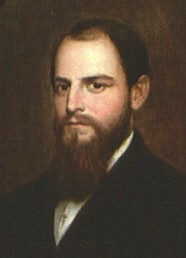
We
have been joined now by a special guest, a man who serves Fisk as
both music professor and treasurer, Mr. George Leonard White.
Thank
you. I am honored to have served at Gettysburg, and I am
honored to be here at this conference, to which I have brought with
me some of my vocal students.
We
understand that your songsters will shortly be providing music for us. |
 |
That is
correct. We had hoped to be welcomed during the formal
proceedings of the Council itself, but that did not prove
feasible. Therefore we will be performing during this
intermission. I observe that the delegates have taken the
opportunity to converse and move about the auditorium, but we hope
they will pause and lend an ear.
How
is it that you have traveled this far north?
Well, as
you mentioned, I am the treasurer of our young college, and of that
treasury's dire condition none knows better than I. Six weeks
ago, to raise funds to continue our operation, I used my own savings
to organize a concert tour. I boarded a train with nine young
vocalists to visit the more prosperous regions which were spared from
the war's desolation.

The first
such region is here, my former home state of Ohio. Now it is
true that some at Fisk have expressed fears that we shall engender
only ridicule. Neverthless, we have faith that we have been
called to the North, to sing the money out of the hearts and pockets
of the people.
Is
your effort succeeding?
We have
had, shall we say, mixed results. Many of the people who first
came to hear our young black musicians were expecting a minstrel
show. But no, we aspire to be serious artists. We wish to
absorb the culture of American freedom. Therefore, we present
popular American music and classics from the European tradition, to
demonstrate what higher learning can do for freedmen.
|
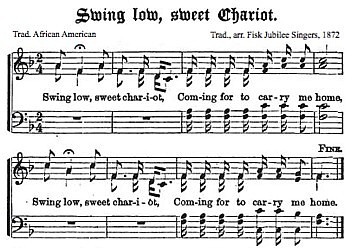
However,
we also include a few songs from our students' heritage in Africa and
America — religious songs.
At first
we performed these only as encores, but white audiences are receiving
the novel tunes with excitement. |
 |
Here is
Ella Sheppard, one of our sopranos, who can tell you more.
|
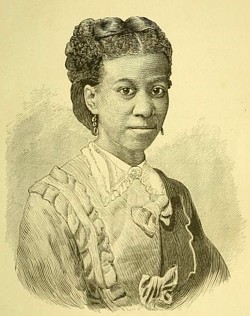 |
Some
of us were reluctant to perform “spirituals” and other
music associated with slavery and the dark past. Those are
secret songs, sacred to our parents, and we never sang them in public
— only in fields and behind closed doors. They represent
things which now are to be forgotten. But Professor White has
begun to collect and arrange these songs for us, and audiences seem
to appreciate them. |
Have
your listeners donated to the collection plate, Professor White?
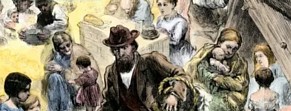
On our
second night out, in Cincinnati, we received contributions of some
fifty dollars. But that happened to be the eighth of October,
which was the night of the great Chicago fire. One hundred
thousand people were left homeless there, a third of the city's population.
|
In the
next day's newspapers we read about those poor people in
Chicago. At once we determined that our small profit should be
donated to the relief fund for the victims of the disaster. |
 |
I
understand that your little band of singers has been retracing the
route of the Underground Railroad, which once led escaped slaves
north to freedom. You've performed in small towns and in cities
like Chillicothe and Columbus.
Yes.
However, I fear that thus far we have failed in our efforts to earn
enough money to cover expenses, let alone being able to send a
remittance back to Fisk. At Columbus the newspapers were not
kind to us, and we were put up in terrible lodgings. We are
tired and discouraged.
But we are
determined to persevere! In particular, we have looked forward
to coming to Oberlin. The college at this place has been
educating black and white students together for 36 years already.
And
I notice that you hope to perform during the Christmas season at
Henry Ward Beecher's famous church in Brooklyn, New York.
If we are
able to do so, perhaps thereby our group will become better known.
What
name have you given to your ensemble?
I have
prayed upon that matter. In the twenty-fifth chapter of the
book of Leviticus we read: A jubilee shall that year be unto you.
Then shalt thou cause the trumpet of the jubilee to sound, and ye
shall proclaim Liberty throughout all the land! We have
talked and sung so much of the “year of Jubilee” that I can
think of no expression that so nearly gives the idea as “the
Jubilee Singers.”
How
appropriate! I'm reminded of the National Peace Jubilee that
was held in Boston a year or two ago.
Indeed.
And a second such event has been proposed for the Fourth of July
next, this time to be styled the World Peace Jubilee and
International Musical Festival. We hope to receive an
invitation. I dare to dream of my Fisk Jubilee Singers standing
before forty thousand and performing “The Battle Hymn of the
Republic.” “He has sounded forth the trumpet that
shall never call retreat. As He died to make men holy, let us
live to make men free!”
But
now, Professor White, I see that you are being beckoned
forward. Go ahead and rejoin your students, for it is now time
for them to sing. I predict that when they lift their voices,
conversations will cease and the entire assembly gathered here at
Oberlin will be spellbound.
Thank you,
sir, for your good wishes.
Professor
White is a tall man, and we see him bending down now and passing
along the pew, giving his vocalists the pitch. And now all is ready.
Ladies
and gentlemen, the Fisk Jubilee Singers.
|
Vann R.
Newkirk II went to Fisk University to research the choir. In
the December 2023 edition of The Atlantic he wrote: |
|
Henry Ward
Beecher, an immensely influential abolitionist and preacher ...
invited the group to sing for his congregation in Brooklyn.
They chose to begin the Brooklyn concert with a dramatic innovation:
singing from the church balcony, obscured from the crowd by a
curtain, their spectral voices filling the nave. And they chose
to lead with “Steal Away,” the spiritual that had gotten
them to Brooklyn in the first place.
According
to Fisk's account of the Jubilee Singers, “So soft was their
beginning that the vast audience looked around to see whence came
this celestial music. Gradually louder and even louder the
voices rose — to a glorious crescendo —and then back down
to a mere whisper, ‘I ain't got long to stay
here.’” As they sang, the curtain was pulled back to
reveal their faces. The audience's reception was rapturous:
“They clamored for more — would not let the singers cease.” |
For
more, here is a feature from Creative
License.
|