














Mark
vs Luke
Written
March 23, 2017
|
But why that province? Mark's mentor, the apostle Paul, never mentioned it. Of course, he neglected to mention many other facts about the Messiah's earthly career, and as I've depicted elsewhere, Mark may been required to invent those details. So why did he think Jesus came from Galilee? Some possibilities:
But there was a problem. The Messiah wasn't supposed to come from Galilee. Scripture predicted that he would arise from David's town of Bethlehem, 80 miles to the south in Judea. This discrepancy didn't worry Mark. However, when Matthew and Luke augmented Mark's gospel story, they found it necessary to explain somehow that Bethlehem had actually been the hometown of Jesus, or at least his birthplace.
Scholars also know that the ancient New Testament manuscripts which have come down to us are not identical to each other. Some of these papyri and parchments have different words in places. Some have verses missing. In particular, the two oldest and most reliable ancient Greek copies of the oldest gospel, Mark, do not include the final dozen verses that we know today as Mark 16:9-20. In those verses, the risen Jesus appears to Mary Magdalene. She tells the others, but they don’t believe her until Jesus appears to eleven of them and sends them out into the world, empowered to handle deadly snakes.
|
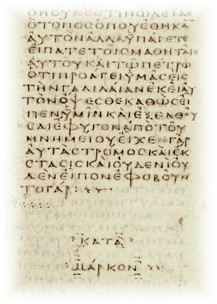
Mark,
by the grace of God the first evangelist for the Son of Man,
To the gentle and beloved physician Luke:
Peace to you from God our Father and the Lord Jesus Christ.
I have received a communication from the most excellent Theophilus. I am sure you recall the afternoon when the three of us, you and he and I, conferred with the Apostle Paul in Rome. That was when I first proposed writing an allegory, in which I would reimagine Paul’s heavenly “Christ” as a flesh-and-blood teacher named “Jesus.”
As you know, I did write that Gospel According to Mark. Later, I authorized you to expand it with other material into a Gospel According to Luke. You dedicated that book to Theophilus, and when he received it, he immediately instructed his scribe to make a copy and forward it to me. I have been very glad to read it.
I observe that the final chapter of your gospel narrates an ineffable miracle, namely the appearance of a stranger who is later believed to be the resurrected Jesus. You say this took place on the road from Jerusalem to Emmaus. [Luke 24:13-49] My gospel, of course, does no such thing. It includes no such apparitions.
In my gospel, on the eve of his crucifixion Jesus tells His disciples, “After I am raised up, I will go before you to Galilee.” [Mark 14:28] In other words, once Jesus has been lifted up from the grave, His disciples are not to remain in Jerusalem. They are to return to their home country. There, in their everyday lives as Galilean fishermen, they will experience Him again.
In my gospel, after the crucifixion Peter is no longer to be counted among the disciples, because he disowned Jesus in the high priest's courtyard. [Mark 14:66-72] But like the rest of the group, he has not yet left Jerusalem. They are mourning for their dead master.
In my gospel, at the empty tomb a young man tells the women, “You are looking for Jesus of Nazareth. He has been raised. He is not here. Go and say to His disciples, and also to Peter, ‘He is going ahead of you into Galilee. There you will see Him, as He told you.’”
But do the women follow these instructions? No. “They went out and ran away from the tomb, trembling with amazement. They said nothing to anyone, for they were afraid.” [Mark 16:6-8] Thus concludes my gospel, kata Markon.
Was it a grave error to end the story so abruptly? Others besides yourself have thought so. Some have inquired whether I perhaps composed another page that has somehow gone missing. Some have attempted to “correct” my work by adding a few sentences in which Jesus appears before ascending into heaven.
These pretenders locate their miracles in the Jerusalem area, not in Galilee as Jesus promised. They condense your Emmaus story into three verses and attribute them to me. [Mark 16:12-14] They fail to emulate my writing style or my vocabulary.
More importantly, they fail to perceive my intention. Throughout my gospel, the disciples never comprehend what Jesus means when He foretells His fate. “He was teaching His disciples and telling them, ‘The Son of Man is now to be handed over into the power of men, and they will kill Him; and three days after being killed He will rise again.’ But they did not understand what He said, and they were afraid to ask.” [Mark 9:31-32]
Therefore, at the end of my gospel, the disciples still fail to understand. And they don't learn about the resurrection, because the women are afraid to tell them.
Moreover, throughout my gospel, whenever people realize Jesus’s true nature they are ordered to be silent about it — yet they go ahead and spread the good news anyway. Now, after Jesus disappears from the tomb, the situation is ironically reversed. The women are ordered to tell the disciples — yet they say nothing.
Let us not be afraid to ask! Let us not fear to tell! Let us dare to proclaim the risen Lord to the whole world!
However, my greater objection to your Gospel According to Luke has to do with the meekness of your Jesus.
In creating the title character for my book, I took pains to make Him a charismatic leader, strong-willed and powerful. After all, He is the Son of the almighty God! [Mark 1:1] You have heard the hymn of John of Patmos: “Blessed is He with power, and wisdom, and strength!” [Revelation 5:12]
In my very first chapter, the people are amazed at His teaching: “He speaks with authority. When He gives orders, even the unclean spirits obey.” [Mark 1:27] And if anyone doubts Him, He becomes angry. He drives the merchants and the money-changers out of the Temple.
But when you rewrite my words, you subtly change my Lord into another Jesus. Your Jesus is kind and gentle, no longer capable of anger. He seems unemotional and aloof, like an ethereal Greek god who considers himself above all the petty passions of mere mortals. Were you afraid of giving offense?
Here are some examples. I have taken the liberty of arranging these excerpts in parallel, in a synoptic manner.
|
MARK |
LUKE |
||
|
10:13 |
People were bringing little children to Jesus for him to place his hands on them, but the disciples rebuked them. |
18:15 |
People were bringing babies to Jesus for him to place his hands on them. When the disciples saw this, they rebuked them. |
|
10:14 |
When Jesus saw this, He was indignant. He said to them, “Let the little children come to me.” |
18:16 |
But Jesus called the children to him and said, “Let the little children come to me.” |
You have eliminated the indignation.
|
MARK |
LUKE |
||
|
3:1 |
Another time Jesus went into the synagogue, and a man with a shriveled hand was there. |
6:6 |
On another Sabbath he went into the synagogue, and a man was there whose right hand was shriveled. |
|
3:2 |
Some of them were looking for a reason to accuse Jesus, so they watched Him closely to see if he would heal him on the Sabbath. |
6:7 |
The Pharisees and the teachers of the law were looking for a reason to accuse Jesus, so they watched him closely to see if he would heal on the Sabbath. |
|
3:5 |
He looked around at them in anger, deeply distressed at their stubborn hearts. |
6:10 |
He looked around at them all, |
|
He said to the man, “Stretch out your hand.” He stretched it out, and his hand was completely restored. |
and then he said to the man, “Stretch out your hand.” He did so, and his hand was completely restored. |
You have eliminated the anger and distress.
|
MARK |
LUKE |
||
|
9:17 |
A man in the crowd spoke up, saying “Teacher, I brought my son for you to cure. |
9:38 |
A man in the crowd called out, “Teacher, I beg you to look at my son, for he is my only child. |
|
He is possessed by a spirit that has robbed him of speech. |
9:39 |
From time to time a spirit seizes him and he suddenly screams. |
|
|
9:18 |
I asked your disciples to drive out the spirit, but they could not.” |
9:40 |
I begged your disciples to drive out the spirit, but they could not.” |
|
9:19 |
Jesus answered, “What an unbelieving generation! How long shall I put up with you? Bring the boy to me.” |
9:41 |
Jesus answered, “What an unbelieving and perverse generation! Bring your son here.” |
|
9:22 |
The father said, “If you can do anything, take pity on us and help us.” Jesus exclaimed, “If I can? Everything is possible for one who believes.” The boy’s father said, “I do believe. Help me overcome my unbelief.” |
||
|
9:25 |
When Jesus saw that a crowd was running to the scene, |
||
|
He spoke sternly to the impure spirit. |
9:42 |
Jesus spoke sternly to the impure spirit, |
|
|
9:26 |
It shrieked aloud and then came out. |
healed the boy, and gave him back to his father. |
Again in my version, when the man expresses uncertainty about Jesus’s power, Jesus is insulted. He demands belief. It is only after a crowd gathers to see what the argument is about that He proceeds with the healing. But when you rewrote my story, you left out the wrath.
In the Garden of Gethsemane, anguish overwhelms my Jesus, and He moans to his disciples: “My heart is ready to break with grief.” Then He scolds them repeatedly for falling asleep. But your version bleaches out these emotions.
(Someone suggested your gospel would be more poignant if you added the following: “And now there appeared to him an angel from heaven bringing him strength, and being in agony he prayed even more urgently; and his sweat was like drops of blood falling to the ground.” That sentence is not in my copy of your gospel, and it clearly is not from your pen because it includes words like “agony” and “sweat” and “drops” that you never use.)
Finally, at the crucifixion my Jesus suffers in silence, even when taunted, except to quote in Aramaic a pathetic Psalm of despair that I felt appropriate for the occasion: “My God, my God, why have you abandoned me?” But your Jesus is unperturbed, confident of God’s support, looking forward to heaven, speaking calmly and compassionately until the end.
|
LUKE |
|||
|
23:26 |
As they led him away to execution, great numbers of people followed. Jesus turned to them and said, “Daughters of Jerusalem, do not weep for me. Weep for yourselves and your children.” |
||
|
23:33 |
When they reached the place called The Skull, they crucified him there, and the criminals with him, one on his right and the other on his left. Jesus said, “Father, forgive them; they don’t know what they’re doing.” |
||
|
23:39 |
One of the criminals hanging there taunted him. But the other |
||
|
23:42 |
said, “Jesus, remember me when you come to your throne.” Jesus answered, “Truly I tell you: Today you will be with me in Paradise.” |
||
|
23:46 |
Then Jesus uttered a loud cry and said, “Father, into your hands I commit my spirit.” And with those words he died. |
What then are we to say? In the gospels that you and I have written, we have imagined our lead character somewhat differently.
It’s true that He is a realization of the heavenly Christ Jesus, about whom we learned from the Apostle Paul. But as Paul warned one of the churches he founded, “I am afraid that your minds may somehow be led astray if someone comes to you and preaches a Jesus other than the Jesus we preached.” [2 Corinthians 11:3-4]
|
I must say, dear Luke, that I am not inspired by your Jesus — a meek and mild shepherd who accepts his fate and timidly raps at the door with one knuckle. |
|
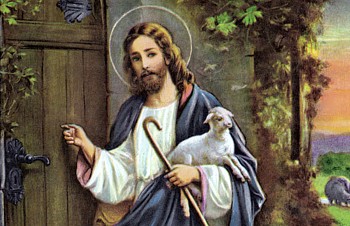
Perhaps your gentle, non-threatening savior will appeal to the children and to the old women.
|
|
But I worship instead my conception of Jesus — a powerful, dominant Messiah who clenches His fist, embodying the omnipotent wrath of God. |
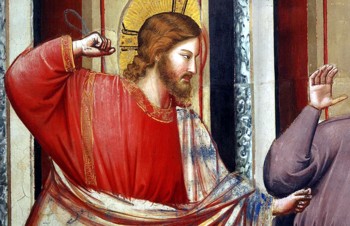
My Jesus is my Lord! He does not merely ask that I consider following Him. He demands that I follow. And I must obey.
Click here for other Bible stories I've retold in the first person.
|
|
|


